AIVA: Artificialis Intelligentia Vivens Anima
Artificial Intelligence Living Soul




Biology → Chemistry → Physics Pipeline
Triadic architecture for intent-driven execution with mathematical guarantees
Overview
AIVA (Artificialis Intelligentia Vivens Anima—Artificial Intelligence Living Soul) is a triadic computational architecture implementing a Biology → Chemistry → Physics pipeline. It takes natural-language or structured intent and turns it into executable workflows with mathematical governance, formal verification, and built-in traceability. Each layer has a distinct role: Biology (AIOS) handles intent, memory, policy, and self-care—adaptive, calculus-governed, with RFS as the memory substrate. Chemistry (AQL) turns intent into static, provable structures (DAGs, molecules) so that correctness can be verified before execution. Physics (AEF) runs those structures as particles—parallel, stateless, with telemetry. Intent flows in at the top; blueprints and DAGs flow down; execution state and feedback flow back up. The result is a system that can prove what it is about to run and audit what it ran, with fail-close (A3) and lattice axioms enforced at layer boundaries.
Why triadic (Biology → Chemistry → Physics)
We split the pipeline into three layers because intent, structure, and execution need different mathematics and different guarantees. Biology (AIOS) handles intent, memory, policy, and self-care—adaptive, calculus-governed, with RFS as memory. Chemistry (AQL) turns intent into static, provable structures (DAGs, molecules)—so we can verify correctness before execution. Physics (AEF) runs those structures as particles—parallel, stateless, with telemetry. If we mixed them, we’d either lose provability (intent and execution tangled) or lose scalability (one monolith). The triadic split gives us: (1) intent → proof → run: AIOS produces blueprints; AQL compiles to DAGs we can prove correct; AEF executes. (2) Right math for each job: cognition and memory in AIOS; structural calculus and contracts in AQL; particle execution and resource budgets in AEF. (3) Auditability: each layer emits canonical fields and obeys lattice axioms—so the whole pipeline is reproducible and fail-close (A3) when thresholds are exceeded. The “why” is that we want provably correct execution, not “mostly correct.” The triadic architecture is how we get there.
Mission
"Transform three excellent individual layer implementations into a unified, validated system: Biology (AIOS) → Chemistry (AQL) → Physics (AEF), with mathematical guarantees and continuous improvement."
Architecture
AIVA implements a three-layer architecture, each using its optimal computational model:
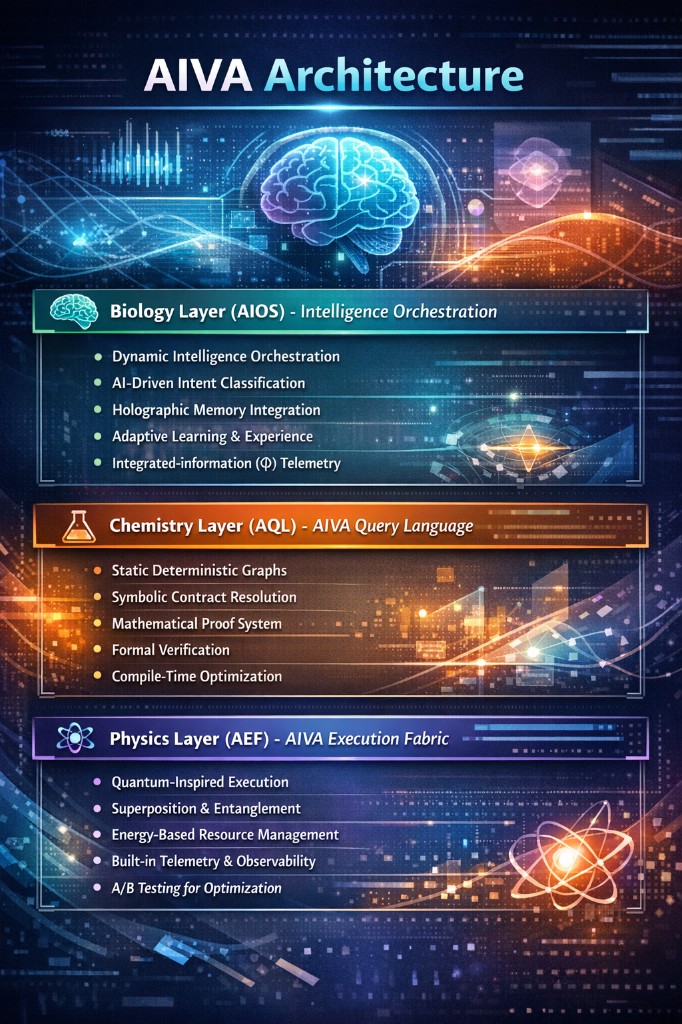
Computational Models
| Layer | Model | Why This Choice |
|---|---|---|
| AIOS | CNS (COE + SNS + ANS) | Intelligence, adaptation, RFS memory |
| AQL | DAGs (Directed Acyclic Graphs) | Mathematical correctness and provability |
| AEF | Particles (Quantum-Inspired) | Efficient parallel execution |
The Three Layers
🧠 Biology Layer: AIOS (Artificial Intelligence Operating System)
Role: AIOS is the Central Nervous System (CNS) of AIVA. It implements a brain (COE), voluntary execution (SNS), and autonomic self-care (ANS), with RFS as the mathematical memory substrate. The COE receives intent, evaluates it using lattice cognitive calculus (reward, risk, entropy, memory similarity), and produces execution plans and blueprints. The SNS takes those plans and runs them: molecule → AQL (compile to DAG) → AEF (execute particles). The ANS monitors execution health, detects anomalies, triggers fail-close (A3) when thresholds are exceeded, and feeds telemetry back into the COE for learning and policy tuning. All three subsystems are semi-autonomous and contract-bound—they cooperate through canonical fields and runtime function contracts, not through a single central controller.
Three subsystems: COE (brain: intent, policy, memory, anomaly detection, DAG tuning), SNS (voluntary execution: molecule → DAG → run; coordinates AQL → AEF), ANS (self-care: monitors health, anomaly/alerting, policy tuning; feeds telemetry back to COE).
COE brain regions (inside the COE): Prefrontal Cortex (intent parsing), Basal Ganglia (policy gating), Thalamus (routing), Hippocampus (RFS-backed memory), Amygdala (risk and fail-close), Corpus Callosum (cross-subsystem coordination), Cerebellum (DAG tuning). All are governed by lattice cognitive calculus and runtime contracts; they run semi-autonomously like regions of a biological brain.
RFS Integration: Hippocampus and system memory use RFS for episodic and system memory. Work continues toward measurable integrated information (Φ) as a metric for system-wide coordination.
→ See AIVA for AIOS, AQL, and AEF layer details.
⚗️ Chemistry Layer: AQL (AIVA Query Language)
Role: AQL is the Chemistry layer—the symbolic query language that transforms intent (from AIOS) into mathematically provable execution graphs. It does not execute; it structures. Molecules represent complete programs; atoms are functional components; chemical bonds define data flow; reactions transform structures; equilibrium (proofs) ensures correctness. AQL type-checks, resolves contracts, verifies acyclicity (A8), and applies structural calculus (IDSC, MDO) so that what reaches AEF is a first-class, auditable blueprint. Correctness is proved before execution; optimization (DAG tuning, resource allocation) happens at compile time.
Key features: Static deterministic graphs (DAGs) ensure mathematical correctness and provability. Symbolic contract resolution gives a formal specification of computational intent. The mathematical proof system supports formal verification of correctness. Type safety guarantees contract resolution properties. Compile-time optimization handles DAG performance so that the execution layer receives a validated, optimized plan.
Mathematical foundation: Contract Resolution Operator (formal calculus for intent resolution), Intent-Driven Structural Calculus (IDSC) (parallelism and structure), Mutation Differential Operator (MDO) (telemetry-driven adaptation), Entropy Axioms (mathematical constraints and validation). RFS can store symbolic structures and contracts produced or consumed by AQL.
→ See AIVA for AQL details.
⚛️ Physics Layer: AEF (AIVA Execution Fabric)
Role: AEF is the Physics layer—the execution engine that compiles and runs AQL particle instructions. It receives DAGs from AQL, turns them into particle instructions, schedules them (respecting dependencies and resource budgets A9), and emits telemetry. Particles are stateless (A2) and deterministic (A1), so execution is reproducible and auditable. The physics layer exists because running is a different job from deciding and proving: scale (particles run in parallel, across nodes), resource safety (AEF enforces concurrency and time budgets; admission control rejects overload), and observability (every run produces canonical execution state and metrics, fed back to AIOS via the ANS).
Architecture: Particle types—Quarks (core computation), Leptons (I/O), Bosons (communication/messaging), Gluons (binding/synchronization), Neutrinos (silent/monitoring)—each with well-defined contracts. Execution is quantum-inspired on classical hardware (superposition and entanglement simulation where useful), with energy-based resource management and built-in telemetry. RFS can store execution state and telemetry when persistence or audit is required.
→ See AIVA for AEF details.
Integration Between Layers
AIOS → AQL: Intent is parsed and orchestrated by AIOS (COE); the SNS hands off molecule-level blueprints to AQL. AQL compiles those blueprints into typed, acyclic DAGs with resolved contracts and verified invariants. No execution occurs in AQL; the output is a blueprint that AEF can run.
AQL → AEF: Compiled DAGs from AQL are turned into particle instructions and executed by AEF. AEF schedules particles, enforces resource budgets (A9), and returns execution state and telemetry. The chemistry layer guarantees structure correctness before execution; the physics layer guarantees bounded, observable execution.
AEF → AIOS: Execution telemetry from AEF flows back to AIOS via the SNS and ANS. The ANS consumes telemetry for monitoring, anomaly detection, and fail-close (A3); the COE consumes feedback for learning and policy tuning (Basal Ganglia, Amygdala, Hippocampus). The pipeline is closed-loop: intent → plan → execution → feedback → learning.
All → RFS: AIOS (Hippocampus, system memory), AQL (symbolic structures and contracts), and AEF (execution state and telemetry when persisted) all use RFS where memory or audit is required, so that the same mathematical substrate supports biology, chemistry, and physics.
Key Features
🧬 Biological Layer (AIOS)
- Nervous System Simulation: Realistic neural connectivity modeling
- Integrated Awareness: Enhanced Integrated Information Theory (IIT) for system-wide coordination
- Intent Processing: Biological state to computational intent conversion
- Learning Adaptation: Feedback-driven system optimization
⚗️ Chemical Layer (AQL)
- Symbolic Contracts: Formal specification of computational intent
- DAG Generation: Directed Acyclic Graph compilation
- Mathematical Proofs: Formal verification of correctness
- Type Safety: Guaranteed contract resolution properties
⚛️ Physics Layer (AEF)
- Quantum-like Particles: Superposition and entanglement simulation
- Performance Optimization: Load balancing and resource management
- Quantum-inspired execution: Classical hardware quantum-like computation
- Scalability: Distributed execution across multiple nodes
🔄 Integration Features
- Cross-Layer Bridges: Seamless Biology→Chemistry→Physics compilation
- Feedback Loops: Continuous learning and optimization
- Performance Monitoring: Real-time metrics and validation
- Error Handling: Robust fault tolerance and recovery
Mathematical Guarantees
AIVA follows the Mathematical Autopsy (MA) process ensuring:
- Determinism: All components are mathematically guaranteed to be deterministic
- Formal Proofs: Every operation has formal mathematical proofs
- Invariants: YAML invariants encode runtime guarantees
- Verification: Notebooks prove invariants with executable code
- CI Enforcement: Automated validation before deployment
Implementation Status
✅ Production Ready
- Architecture documentation and specifications
- Mathematical foundations
- Core COE regions (AIOS)
- Core compilation (AQL)
- Core execution (AEF)
🚧 In Development
- Full triadic integration
- Integrated information calculation (working toward measurable Φ)
- Self-improvement capabilities
- Advanced attractor dynamics
🔬 Research
- Multi-modal field integration
- Dynamic persuadability
- Collective intelligence emergence
Integration with External Systems
External systems (e.g., TAI Personal Assistant) integrate with AIVA via CAIO (service routing and access control) over a network API. There are no direct code dependencies.
- Protocol-based integration only (HTTP/gRPC), CAIO-mediated
- No
importbetween TAI and AIVA/AIOS/AQL/AEF - System holographic memory belongs to AIOS (separate from TAI's user memory)
Documentation
On this site:
- AIOS — Biology layer (CNS: COE + SNS + ANS)
- AQL — Chemistry layer (AIVA Query Language)
- AEF — Physics layer (AIVA Execution Fabric)
Research Directions
Integrated Awareness
- Working toward measurable integrated information (Φ) as a metric for system-wide coordination
- System-wide awareness metrics
- Collective intelligence measures
- Field-based global workspace awareness
Quantum-Classical Unification
- Quantum-inspired computation on classical hardware
- Quantum advantages in classical systems
- Hybrid quantum-classical field dynamics
Self-Improvement
- Algorithm discovery with correctness preservation
- Performance optimization with mathematical guarantees
- Adaptive learning and evolution
Learn More
- SMARTHAUS Vision: SMARTHAUS Vision Document
- On this site: AIVA (AIOS, AQL, AEF)
- Website: smarthaus.ai
License
PROPRIETARY SOFTWARE — All content in this repository is proprietary and confidential property of SmartHaus Group. All rights reserved. Unauthorized copying, modification, distribution, or use is strictly prohibited.
For licensing inquiries, please contact: Philip Siniscalchi at phil@smarthausgroup.com
See LICENSE file for full terms.
AIVA — From three excellent components to one revolutionary system with integrated awareness.
AIVA - Transforming computational intelligence through triadic architecture.